ICES, ISDP and Huayang Center Webinar | Hai-Eu Dialogue Series Webinar I - Institutional Opening Up: Advancing Free Trade Port Governance and Connectivity
Hosted by the Institute of China-Europe Studies (ICES), the Stockholm China Center at the Institute for Security and Development Policy (ISDP) and the Huayang Center for Maritime Cooperation and Ocean Policy.
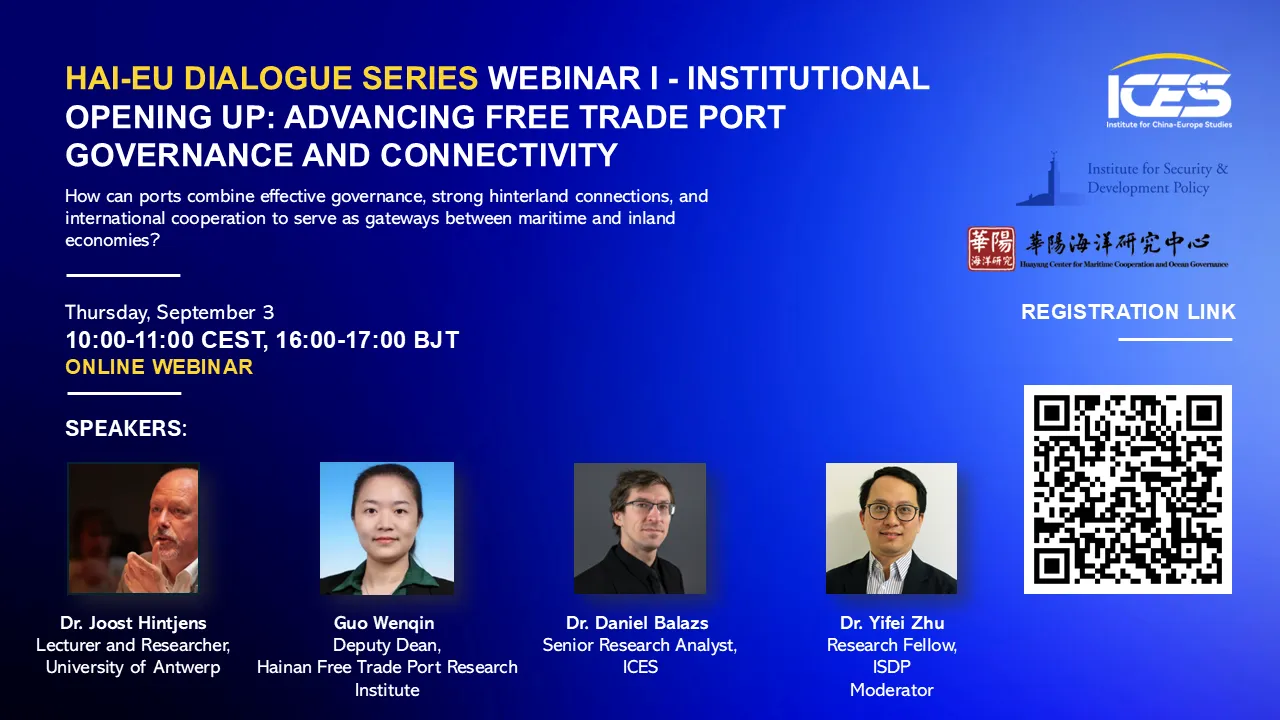
Source: ICES
Date: Thursday, September 3, 2026
Time: 10:00–11:00 CEST, 16:00–17:00 BJT
Speakers:
- Dr. Joost Hintjens, Lecturer and Researcher, Department of Transport and Regional Economics, University of Antwerp
- Guo Wenqin, Deputy Dean, Hainan Free Trade Port Research Institute
- Dr. Daniel Balazs, Senior Research Analyst, Institute for China-Europe Studies
Moderated by Dr. Yifei Zhu, Research Fellow at ISDP's Stockholm China Center
Summary
Dr. Joost Hintjens started off the presentations by highlighting the importance of hinterland connectivity in ports. Indeed, while port operators usually are well aware of foreland and port operations themselves, they are usually much less aware of where products go once they leave the port to join the hinterland.
His presentation gave a quick breakdown of European port infrastructure and what the European TEN-T projects are, with its nine corridors (including the UK one) and core ports in the network. 51% of the maritime traffic of those ports is in the Hamburg to Le Havre range, and 29% is located in just two ports, Rotterdam and Antwerp.
While Rotterdam and Antwerp handle such a large share of shipping, they are relatively small cities, which begs the question of why they reached this level of capacity. According to Dr Hintjens, this is largely due to their location within the so-called 'blue banana' of Europe, where wealth is most concentrated and infrastructure in rail, inland rivers and short sea shipping is also very concentrated and dense.
Guo Wenqin's presentation focused on Hainan as a potential hub for connectivity, especially with Southeast Asia and the future cooperation avenues with ASEAN. This would be especially interesting for both China and ASEAN countries considering the potential for common market growth in the blue economy sector, something present in China's latest Five-Year Plan.
With its prime location in Southern China, Hainan can function as a hub connecting Northeast and Southeast Asia, in a sea area rich with resources and with the added advantage of benefiting from an island-wide special customs operation.
Finally, the deputy dean of the Hainan Free Trade Port Research Institute talked of the port's potential to promote overall port connectivity, better connect fishery markets between China and ASEAN, develop common tourism ventures and encourage energy transition.
Dr. Daniel Balazs summarised the recent geopolitical and narrative context of EU-China maritime cooperation to explore possible synergies between European ports and the Hainan one.
After 2020 and because of supply and security shocks, the EU started pursuing economic security and derisking policies. This extended to maritime affairs and port strategy, as the ownership and management of the latter have now become a securitised issue, in which the share of foreign actors is more tightly controlled. By contrast, China's narrative focuses on expanding connectivity, the Belt and Road Initiative, and reliability.
There are still avenues for cooperation between China and the EU on those matters, however, according to ICES' senior researcher. Four areas were identified: green shipping, IUU fishing, data governance and hinterland connectivity/intermodal transport. Identifying these areas only represents a first step; however, more research is needed to evaluate the feasibility.
In responding to questions from the audience on what the biggest challenges are for improving port governance and connectivity, the guest speakers mentioned the disconnect between ship and port operators with hinterland information, the need for better standards and data sharing, and the overall uncertainty on EU-China trade relations that hampers long-term visibility on future policy.
About the Hai-Eu Dialogue Series
The Hai-Eu Dialogue: Europe–China Perspectives on Ocean Governance and Sustainable Development in the Era of the Hainan Free Trade Port ("海欧"传声:海南自由贸易港时代的中欧海洋治理与可持续发展对话) is a joint initiative of the Institute for China-Europe Studies (ICES), the Stockholm China Center at the Institute for Security and Development Policy (ISDP) and the Huayang Center for Maritime Cooperation and Ocean Policy. Drawing on the three institutions' expertise in international relations and maritime affairs, the series provides a Track II platform for exchanges among experts, practitioners, and the wider public. It seeks to foster mutual understanding, facilitate policy dialogue, and examine the scope for closer coordination between Europe and China on maritime issues.
If you were unable to follow the discussion live, we invite you to watch the full recording
via:
https://youtu.be/TQhE7x-fCCQ?si=O8hSJIFt0aHDW1B_
Institute for China-Europe Studies|中欧关系研究中心 Rond-Point Schuman 6, 1040 Brussels|https://ices-eu.org|+32 (02) 234 63 97